DuoMash
Last Updated:
In 30 Seconds
DuoMash was a small social experiment that randomly paired one boy and one girl every day.
I built it to encourage interaction between students in my new college while also challenging myself to build my first real web application with authentication, a database, and real users.
The experiment lasted only three days before I shut it down, but it taught me one of the biggest lessons about building products.
Screenshot
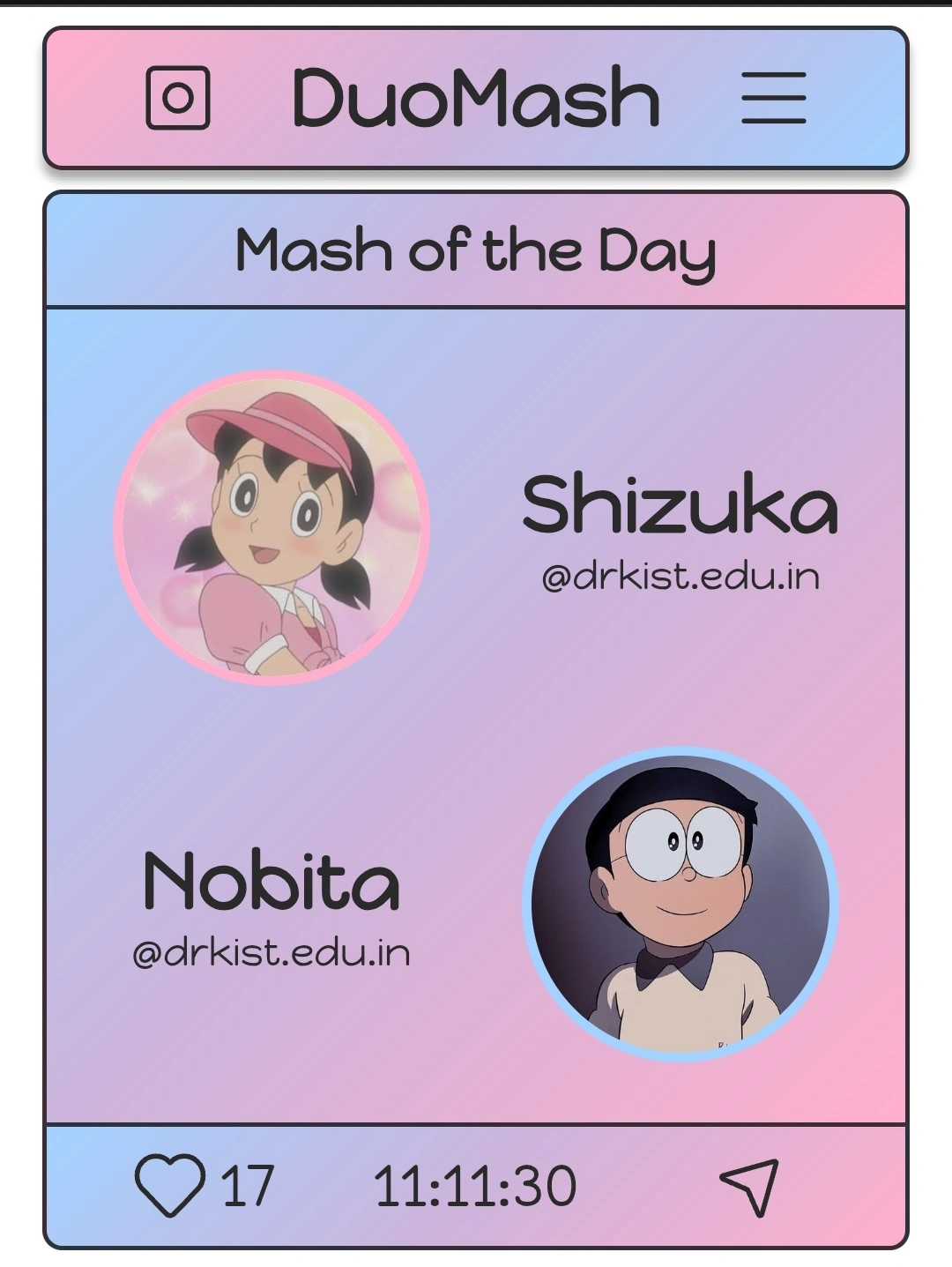
Spark
When I joined college, I noticed something.
My entire friend circle consisted of boys. We never talked to girls, and girls never talked to us. There was almost no interaction between the two groups.
Around the same time, I watched The Social Network. The FaceMash interface caught my attention. Instead of comparing people like the movie, I got a different idea.
What if every day one random boy and one random girl were paired together?
Not as a competition, but simply to encourage people to know each other.
That idea became DuoMash.
Vision
At that time, I had just started learning backend development. Until then, I had only built static websites.
I wanted to build something that felt like a real web application.
DuoMash became my first project with user authentication, a real database, user profiles, and backend logic.
Since I couldn’t afford a server that supported scheduled jobs, I couldn’t automate the daily pairing process. Instead, every day I manually logged into the admin panel and clicked a button to generate a new pair.
It wasn’t the perfect solution, but it worked, and it allowed me to launch the project without spending money.
Journey
The idea spread very quickly among the boys in my college.
Within three days, more than a hundred boys had registered.
But fewer than ten girls joined.
That completely broke the idea.
Since there weren’t enough girls, the same girls kept getting paired again and again while many boys never got matched.
Technically, everything was working exactly as I had built it.
The real problem wasn’t the code.
The real problem was the people.
What Went Wrong
The biggest mistake I made wasn’t technical.
It was assuming I understood the users before talking to them.
I designed the product based on what I thought people wanted instead of asking them first.
As more people started using DuoMash, I also realized it was slowly being perceived differently from what I had originally intended. My goal was simply to encourage friendly interaction, but I became uncomfortable with the direction it was taking.
Instead of trying to force the project to continue, I decided to shut it down after only three days.
Looking back, I think that was the right decision.
What I Learned
DuoMash changed the way I think about building products.
Before this project, I thought if the code worked, the project would work.
After DuoMash, I realized that’s not true.
People don’t always use products the way developers imagine.
This project also became my first real experience building authentication, working with databases, handling real users, and maintaining a web application.
Technically, it was a huge step forward.
But the biggest lesson wasn’t about programming.
It was about understanding people before building for them.